
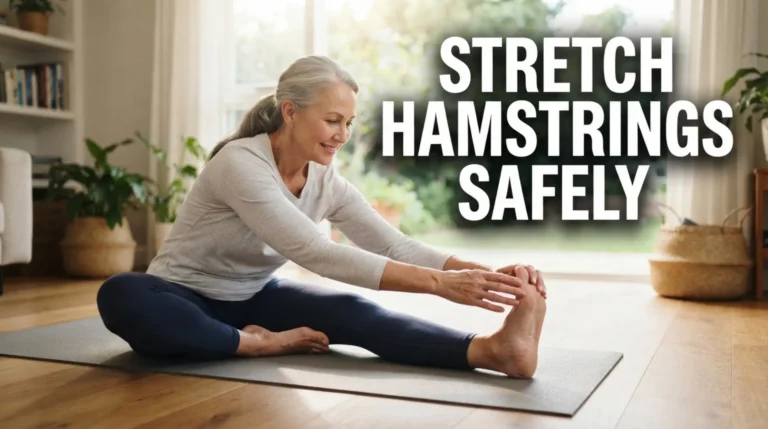
🎯 Quick Answer
How to stretch hamstrings safely: The safest way for seniors to stretch hamstrings is using a seated or towel stretch while avoiding bouncing, keeping the spine straight, and holding for 30–60 seconds. Key points:
• Identify the difference between a safe stretch and one that contributes to lower back pain. • Learn the proper biomechanics to protect your joints and help avoid a pulled hamstring. • Discover 3 low-impact, accessible routines you can do at home today.
Continue reading for the complete guide to safe hamstring stretching and the 7 mistakes you should avoid.
If you’ve noticed your legs feeling tighter or your lower back aching more often, you aren’t alone. As we age, our muscles naturally lose some elasticity, making everyday activities like bending down or walking longer distances more challenging. Many adults over 55 want to know how to stretch hamstrings safely without risking a fall, but standard fitness advice is often designed for younger bodies. Trying to force extreme flexibility can cause more harm than good, potentially leading to pulled muscles or joint pain. In the United States, maintaining functional mobility is a top priority for active aging, and learning to do it safely is step one.
This guide is specifically designed for your body’s changing needs. We’ll explore exactly how to stretch hamstrings with a focus on joint preservation and injury prevention rather than pushing for extreme flexibility. We will cover the seven most common mistakes older adults make—like bouncing or stretching cold muscles—and provide three accessible, low-impact routines you can do safely at home. Let’s look at how you can improve your mobility and maintain your independence securely.
👤 Written by: Stretching Daily Editorial Team Reviewed by: Stretching Daily Wellness Team, Senior Fitness Specialists Last updated: 13 August 2026
ℹ️ Transparency: This article explores how to stretch hamstrings based on scientific research and guidelines from authoritative bodies like the CDC and NIA. Some links may connect to our products/services. All information is verified and reviewed by our Senior Fitness Specialists. Our goal is accurate, helpful information.
7 Hamstring Stretching Mistakes That Cause Senior Injuries
To avoid pulling a hamstring, it is crucial to recognize that aging muscles require a different approach to stretching than they did in our twenties. The tendons and connective tissues surrounding our hamstrings gradually lose water content and elasticity over time, which means they respond differently to force and movement. Traditional stretching advice—often geared toward athletes or younger fitness enthusiasts—can actually increase injury risk for adults over 55. Understanding these seven common mistakes can help you protect your joints and maintain your hamstring flexibility safely.
Mistake 1: Bouncing (Ballistic Stretching)
Bouncing during a stretch, known as ballistic stretching, is one of the most common and potentially harmful habits. When you bounce, the rapid movement can trigger your body’s stretch reflex—a protective mechanism that causes the muscle to contract suddenly instead of lengthening. For aging muscles that are less elastic, this sudden contraction can lead to a hamstring strain or micro-tears in the muscle fibers. According to the ACSM’s exercise guidelines, while ballistic stretching isn’t inherently shown to cause injury in all populations, the rapid increase in muscle tension can trigger the stretch reflex, making it a mechanically riskier choice compared to static stretching.[5] A slow, steady hold is a much safer alternative for your body.
Mistake 2: Pushing Past Pain
There’s an important difference between feeling a gentle pull and experiencing sharp or burning pain. Many people believe that a stretch should hurt to be effective, but overstretching hamstrings beyond their comfortable range can lead to tissue damage rather than improved flexibility. A safe stretch feels like mild tension—not pain. If you feel a sharp sensation, ease back immediately. Pushing through pain doesn’t accelerate progress; it often sets you back by creating inflammation or small tears that take weeks to heal.
Mistake 3: Improper Spine Alignment
Poor spine alignment during hamstring stretches is a leading contributor to lower back pain stretching injuries. When you round your lower back instead of hinging at the hips, the stretch transfers from your hamstring to your lumbar spine, placing excessive stress on the discs and ligaments in your back. To check your form, place one hand on your lower back as you stretch. If you feel your spine curving outward, you’re rounding—stop and reset by tilting your pelvis forward slightly while keeping your chest lifted.
Mistake 4: Stretching Cold Muscles
Stretching cold muscles is a common mistake that significantly increases the risk of injury, particularly for older adults. Cold muscles are less pliable, have reduced blood flow, and are more susceptible to micro-tears when stretched. Before any hamstring stretching routine, warm up with 5–10 minutes of gentle movement—walking in place, marching with light arm swings, or slow pedaling on a stationary bike. This increases blood flow to the muscles and prepares the tissues for safe lengthening.
Mistake 5: Locking the Knees
Fully straightening and locking the knees during a hamstring stretch places excessive pressure on the joint capsule and can lead to a hyperextended knee. This is especially risky for seniors whose cartilage and ligaments may already be thinning. Instead, keep a slight, soft bend in the knee—sometimes called a “micro-bend”—throughout the stretch. This small adjustment protects the joint while still allowing an effective stretch along the back of the thigh.
Mistake 6: Holding Your Breath
It may seem unrelated, but holding your breath during a stretch works against you. When you hold your breath, your muscles tense up reflexively, reducing the effectiveness of the stretch and increasing the risk of a spike in blood pressure. Deep, rhythmic breathing—inhaling through the nose and exhaling slowly through the mouth—helps activate the parasympathetic nervous system, encouraging your muscles to relax and lengthen more naturally. Think of each exhale as an opportunity to ease a little deeper into the stretch.
Mistake 7: Rushing the Process
Impatience is one of the most overlooked stretching mistakes. Aging muscles and connective tissues need more time to respond to a stretch, and rushing through a routine can lead to injury rather than improvement. This is especially important for pulled hamstring recovery and prevention—if you’ve experienced a previous strain, returning to stretching too aggressively can re-injure the tissue. Commit to holding each stretch for a full 30–60 seconds, and build your routine gradually over weeks rather than days. Consistency, not intensity, yields lasting results.
Avoiding these seven mistakes is the foundation of protecting your joint health and building sustainable flexibility. Each one addresses a specific physiological reality of aging—from reduced elasticity to slower nervous system responses. Now that we know what to avoid, let’s explore the science behind why our bodies react this way to stretching as we age.
The Science of Senior Flexibility: What You Need to Know
Generic fitness advice often tells you to “hinge at the hips and keep your back straight,” but it misses crucial details about how older bodies actually feel and process movement. What’s frequently absent from that guidance is an understanding of how our nervous system changes with age—and how the real-world environment in our homes can turn a simple stretching session into a fall risk. These aren’t minor details; they’re the difference between a safe, effective routine and one that could lead to injury. Understanding these changes is key to fall prevention for seniors, and it’s what separates age-appropriate stretching guidance from one-size-fits-all advice.
The Proprioception Deficit
Proprioception—your body’s ability to sense its own position in space—naturally declines as we age. This means that when someone tells you to “keep your back straight,” you may genuinely believe you’re doing so while your spine is actually rounding forward. This isn’t a failure of effort; it’s a neurological change. To compensate, use tactile feedback techniques. For example, place one hand on your lower back while performing a seated hamstring stretch. If you feel your spine curving outward under your palm, you know to adjust. Another effective cue is to imagine lengthening through the crown of your head, as if a gentle string is pulling you upward. These specific physical cues give your body the external feedback it needs when internal signals become less reliable.
The Aging Stretch Reflex
Understanding the difference between static vs dynamic stretching becomes especially important as we age. Muscle spindles—the sensory receptors inside your muscles that detect changes in length—become less sensitive over time. Simultaneously, older muscles lose a significant proportion of fast-twitch fibers, meaning the body responds more slowly to sudden changes in muscle length. When you bounce during a stretch (dynamic or ballistic movement), your less-responsive muscle spindles may not detect the rapid lengthening quickly enough, and the delayed protective contraction can result in micro-tears rather than a smooth stretch. This is precisely why static holds of 30–60 seconds are so important for adults over 55. A slow, sustained stretch gives your nervous system adequate time to register the lengthening and gradually allow the muscle to release, rather than triggering a sudden, potentially harmful contraction.
Environmental Safety and Fall Risks
Before you even begin stretching, your environment matters. A typical American home presents numerous hazards that can turn a simple standing stretch into a dangerous fall: slippery hardwood or tile floors, loose throw rugs, unstable furniture that slides when leaned on, and cluttered walkways. According to the CDC’s fall statistics, more than one out of four older Americans falls each year, and 3 million are treated in emergency departments for fall injuries.[1] Ensuring a safe environment before stretching is critical. Before each session, take a moment to clear the area around you, ensure any chair or surface you’ll use for support is stable and won’t slide, and consider using a yoga mat or non-slip surface. These simple environmental checks are an essential part of learning how to prevent falls during your wellness routine.
As the National Institute on Aging emphasizes, maintaining mobility is key to living independently as we age, and safe practices are essential to helping prevent disability.[3] Our routines at Stretching Daily prioritize these biomechanical and environmental details because understanding how to stretch hamstrings effectively means accounting for the whole picture—not just the muscle, but the nervous system and the space around you.
3 Safe, Low-Impact Hamstring Stretches You Can Do at Home
The most effective hamstring stretches for seniors focus on stability and control, ensuring you get the benefits without the risk. The three routines below are designed specifically for aging bodies—each one removes or minimizes balance challenges while providing a safe, effective stretch. As the WHO’s physical activity guidelines recommend, adults aged 65 and older should aim for at least 150 to 300 minutes of moderate-intensity physical activity per week, and incorporating these stretches into your routine can support that goal.[2]
The Seated Hamstring Stretch (Chair Hamstring Stretch)
This seated hamstring stretch is an excellent starting point because it removes balance from the equation entirely, allowing you to focus on form and breathing.
- Sit on the edge of a sturdy chair. Make sure the chair is on a non-slip surface and will not roll or tip.
- Extend one leg straight out in front of you, placing your heel on the floor with your toes pointing up toward the ceiling.
- Keep your back straight by using the hand-on-back tactile cue—place one hand on your lower back to monitor your spine’s position.
- Gently hinge forward from the hips until you feel a mild stretch along the back of your extended thigh. Do not round your back.
- Hold for 30–60 seconds, breathing deeply and steadily. Repeat on the other side.
This chair hamstring stretch is particularly well-suited for those who experience dizziness when changing positions or who have significant balance concerns.
The Towel Hamstring Stretch (Bed or Floor)
The towel hamstring stretch offers controlled stretching for those who prefer lying down, and it can be one of the most comfortable hamstring stretches in bed or on a padded floor surface.
- Lie flat on your back on a firm mattress, yoga mat, or carpeted floor.
- Loop a towel or long strap around the arch of one foot, holding one end of the towel in each hand.
- Gently pull the towel to lift your leg straight up toward the ceiling, keeping the leg as straight as comfortable.
- Keep the other leg flat on the surface or bent at the knee for added lower back comfort.
- Hold for 30–60 seconds, using slow, deep breaths to help the muscle release. Repeat on the other side.
The towel gives you precise control over the intensity, making this a safe and adaptable option for varying flexibility levels.
The Supported Standing Hamstring Stretch
For those who prefer a standing hamstring stretch, this version builds in stability support to reduce fall risk.
- Stand behind a sturdy chair or kitchen counter, placing both hands on the surface for balance.
- Place one heel on a low step, stool, or thick book (no higher than 6–8 inches to start).
- Keep the knee of your elevated leg slightly soft—avoid locking it straight.
- Hinge forward at the hips, keeping your spine straight and chest lifted, until you feel a gentle stretch.
- Hold for 30–60 seconds, breathing steadily. Repeat on the other side.
This standing option is ideal for hamstring stretches for seniors who want to incorporate stretching into daily activities, such as while waiting for the kettle to boil.
Consistency with these safe methods typically yields better results than forcing deeper stretches. If you have additional questions about technique or timing, the frequently asked questions below address the most common concerns.
Frequently Asked Questions
What are the best stretching exercises for seniors?
Effective stretching exercises for seniors focus on major muscle groups and prioritize stability, such as seated hamstring stretches, calf stretches against a wall, and gentle neck rolls. These exercises can help maintain functional mobility without placing excessive stress on the joints. Prioritize static holds over bouncing movements for safety. Consult a professional if you experience sharp pain. Results may vary based on individual health conditions.
How can I improve my leg strength after 50?
You can improve leg strength after 50 by incorporating low-impact resistance exercises like chair squats, step-ups, and targeted stretching. Combining strength training with a consistent stretching routine may improve both muscle power and flexibility. This dual approach can be essential for maintaining balance and independence. Explore essential exercises to keep you strong for more guided routines. Results may vary, so start slowly.
How do I safely perform knee exercises on a chair?
To safely perform knee exercises on a chair, sit upright in a sturdy, armless chair with your feet flat on the floor. Slowly extend one leg straight out, hold for a few seconds, and gently lower it back down. This can help build quadriceps strength without putting excessive load on the knee joint. Ensure the chair will not slide on your floor by placing it against a wall or on a non-slip mat.
What should I do if I fall and can’t get up?
If you fall and can’t get up, stay calm, assess your body for injuries, and try to slide or crawl to a sturdy piece of furniture. Use the furniture to support yourself as you slowly attempt to rise. If you cannot move, use a medical alert device, phone, or make noise to attract attention. For a more detailed guide, read about steps for seniors who fall and can’t get up.
How to stretch tight legs safely without falling?
To stretch tight legs safely without falling, use a stable support system like a sturdy chair, a wall, or perform stretches while seated or lying down. Avoid stretching in the middle of a room where balance can easily be lost. Environmental safety is just as important as the stretching technique itself. Always check your surroundings before beginning any routine.
How long to hold a hamstring stretch for seniors?
Seniors should hold a hamstring stretch for 30 to 60 seconds. Because aging muscles and connective tissues respond more slowly, longer, gentle static holds tend to be more effective and safer than short, bouncing stretches. Remember to breathe deeply and avoid pushing past the point of mild tension. Individual flexibility levels will vary.
Should I use a towel for hamstring stretching?
Yes, using a towel for hamstring stretching is recommended for seniors. A towel allows you to control the intensity of the stretch while lying comfortably on your back, removing balance concerns and helping protect your lower back from strain. It is an excellent tool for safe, modified stretching at any flexibility level.
How to avoid lower back pain while stretching hamstrings?
To avoid lower back pain while stretching hamstrings, hinge at the hips rather than rounding your spine. Place a hand on your lower back to feel the alignment; if your back curves outward, you are bending incorrectly. Seated or lying stretches also naturally reduce lower back strain. Adjust intensity based on your comfort level.
Is it safe to stretch cold muscles?
No, it is generally not safe to stretch cold muscles, especially for older adults. Cold muscles are less pliable and more prone to micro-tears. Warm up with 5–10 minutes of light activity, such as walking in place or gentle arm circles, before beginning your stretching routine. This preparation can help reduce injury risk significantly.
Why is bouncing bad when stretching?
Bouncing is bad when stretching because it triggers the stretch reflex, causing the muscle to contract rapidly to protect itself. In older adults, this reflex can contribute to muscle strains or tears because aging muscles are less elastic. Static stretching, where you hold a position steadily, is a much safer alternative for most people.
Limitations, Alternatives & Professional Guidance
While research strongly supports the benefits of stretching for older adults, it’s important to acknowledge that studies on specific stretching modalities in older populations are still evolving. For example, in a 2024 comparative study with 15 active healthy older adults (mean age 64), researchers found that stretching knee flexors did not result in a statistically significant change in joint position sense (absolute error changed from 3.80° to 4.84°, p=.38).[4] This suggests that while stretching may offer many benefits, the exact mechanisms of how it impacts proprioception in seniors require further investigation. Individual experiences with flexibility also vary greatly depending on past injuries, arthritis, and overall health.
If traditional static stretches cause discomfort, there are worthwhile alternative approaches to consider. Yoga and Tai Chi are evidence-based methods that combine gentle movement with balance training and mindfulness, and both have shown promise in supporting mental clarity and overall well-being. Water aerobics is another effective alternative, as the buoyancy of the water reduces joint stress while providing resistance. Some people also find relief through traditional movements for aging joints that incorporate slow, flowing motions. These alternatives may be preferable for individuals with severe joint pain or balance issues.
It is recommended to consult a healthcare professional or physical therapist before starting a new exercise routine, especially if you have a history of falls, joint replacements, or chronic pain. A professional can provide personalized guidance, ensure your form is correct, and help you address specific mobility limitations safely. No article, no matter how thorough, can replace the value of individualized assessment from a qualified provider.
Conclusion
Understanding how to stretch hamstrings safely is essential for maintaining your independence and reducing the risk of injury as you age. By avoiding common mistakes like bouncing, ensuring a safe environment to help prevent falls, and using controlled, low-impact movements like the seated or towel stretch, you can effectively work toward improved flexibility. Remember that consistency and proper form are far more important than how far you can reach. Individual results may vary, so listen to your body and prioritize safety above all else.
If you found these tips helpful and want to continue prioritizing your functional mobility, consider exploring more resources with Stretching Daily. Our science-backed, age-appropriate routines are designed specifically to support active aging and joint preservation. Join our community and subscribe to our newsletter for daily wellness tips, gentle exercise guides, and supportive advice tailored for adults over 50. Let’s work together to help keep you moving comfortably and confidently.
References
- Centers for Disease Control and Prevention (CDC). “Facts About Falls.” https://www.cdc.gov/falls/data-research/facts-stats/index.html
- World Health Organization (WHO). “Physical Activity Fact Sheet.” https://www.who.int/news-room/fact-sheets/detail/physical-activity
- National Institute on Aging (NIA). “Maintaining Mobility and Preventing Disability Are Key to Living Independently as We Age.” https://www.nia.nih.gov/news/maintaining-mobility-and-preventing-disability-are-key-living-independently-we-age
- Haab, T., Leinen, P., & Stanek, E. (2024). Comparative study on stretching and proprioception in older adults. Muscles. https://pubmed.ncbi.nlm.nih.gov/40757597/
- American College of Sports Medicine (ACSM). “ACSM’s Resources for the Exercise Physiologist.” https://www.acsm.org/docs/default-source/publications-files/acsm-resources-exercise-physiologist-download.pdf


